
1. Application Background
Precision Positioning as a Core Requirement of Robotic Arms
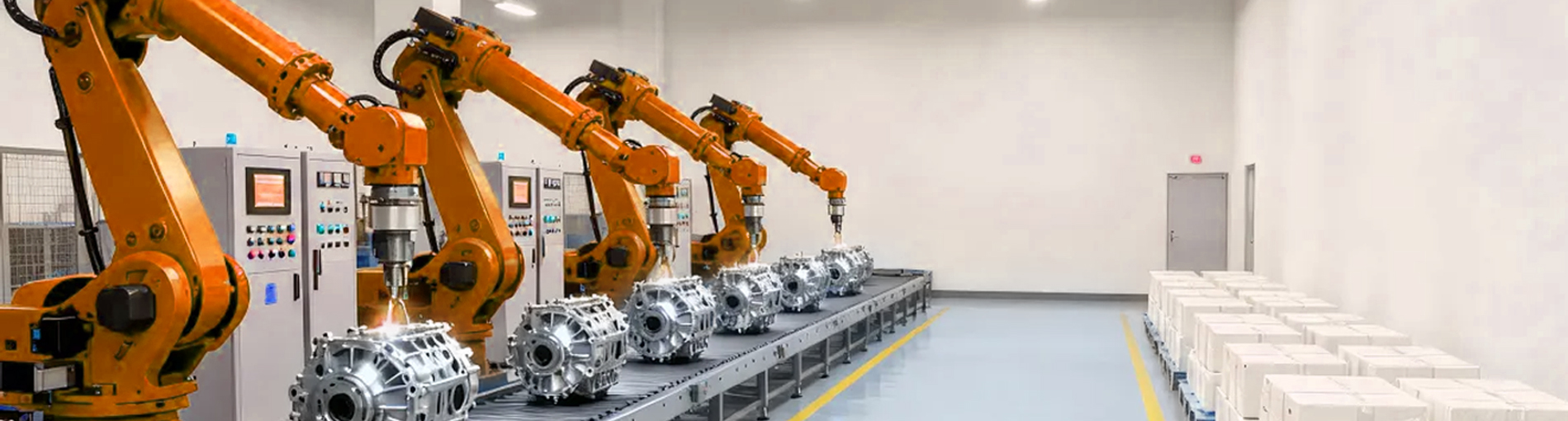
With the continuous advancement of industrial automation, robotic arms are now widely used in manufacturing, assembly, material handling, welding, and inspection tasks. Their ability to accurately perform complex spatial operations makes them a key component in modern industrial systems.
A typical robotic arm consists of motion elements, guiding mechanisms, and the arm body itself. Parameters such as structure design, working range, flexibility, payload capacity, and positioning accuracy directly determine the overall performance of the system.
Most industrial robotic arms operate with multiple degrees of freedom, including:
- Arm extension and retraction
- Horizontal rotation
- Vertical lifting or pitching
All movements are driven by actuators and transmission mechanisms, which must not only support the payload but also bear the weight of the arm, wrist, and end effector.
2. Challenges in Robotic Arm Positioning and Tracking
During operation, precise positioning and trajectory tracking become critical limiting factors for robotic arm performance.
Robotic arm positioning systems rely on close coordination between sensors and controllers. By installing high-precision sensors on the arm and processing the collected data, the controller can calculate motion parameters and accurately control arm movement.
Common positioning technologies include:
- Vision-based positioning
- Laser distance measurement
- Tactile sensing
Among these, vision systems are widely used. Cameras capture images of the arm or target, and computer vision algorithms calculate position and orientation. However, in unstructured or unknown environments, vision-based systems face challenges such as lighting sensitivity, occlusion, and algorithm complexity.
3. Why Laser Distance Sensors Are Used in Robotic Arms
In scenarios where the target is far away, radar, vision, or multi-sensor fusion may be required. However, when the robotic arm operates at close range, traditional measurement methods often lack sufficient accuracy and stability.
In such cases, laser distance sensors provide a reliable solution by offering:
- High measurement accuracy
- Stable performance at close distances
- Fast response
- Minimal sensitivity to ambient lighting
- Non-contact measurement
Laser distance sensors are well suited for end-effector positioning, fine alignment, and distance feedback during grasping and manipulation tasks.
4. Laser-Based Positioning Principle in Robotic Arms
Laser positioning works by mounting a laser distance sensor on the robotic arm or end effector. The sensor emits a laser beam toward the target surface and measures the reflected signal to calculate distance.
This enables the system to:
- Determine the relative distance between the arm and the target
- Assist in fine positioning and alignment
- Improve grasping accuracy
- Reduce collision risk
Compared with purely vision-based systems, laser distance sensors offer higher reliability in close-range precision tasks, especially in environments with poor lighting or complex backgrounds.
5. Recommended Product for Robotic Arm Positioning
L3S Laser Distance Sensor (4–20 mA)
For robotic arm positioning applications, MyAntenna RF L3S laser distance sensor provides a robust and stable measurement solution.
The L3S series uses 650 nm visible red single-point laser technology for non-contact distance measurement and is suitable for industrial automation environments requiring high reliability.
6. Key Technical Parameters of L3S Laser Distance Sensor
Product Model: L3S
Measurement Principle: Phase-shift laser ranging
Laser Type: 650 nm visible red single-point laser
Laser Power: < 1 mW
Performance
- Measurement range: 0.05 – 40 m / 0.05 – 80 m (optional)
- Resolution: 1 mm
- Accuracy: ±(1 mm + D × 5‰), where D is the measured distance
- Repeatability: ±1 mm
- Sampling rate: Selectable 1 Hz / 2 Hz / 5 Hz / 10 Hz / 20 Hz (default 20 Hz)
Electrical & Interface
- Output signal: 4–20 mA analog current
- Power supply: DC 9–36 V
- Power consumption:
- 0.8 W at 20 Hz
- < 0.2 W standby
- System startup time: 600 ms
Environmental
- Operating temperature: –10 °C to +50 °C
- Operating humidity: ≤ 85% RH
- Protection rating: IP56 / IP67 (potting version)
Mechanical
- Zero reference: Front reference
- Cable: Aviation connector
- Housing: Industrial-grade enclosure
7. Interface Speed Considerations
Measurement data transmission speed varies by interface type:
TTL > RS232 > RS485 > 4–20 mA
Although the 4–20 mA interface has a lower data rate, it offers excellent noise immunity and stability, making it suitable for robotic systems operating in electrically noisy industrial environments.
Reducing the measurement range does not improve accuracy.
8. Typical Robotic Arm Applications
The L3S laser distance sensor can be applied to:
- End-effector distance feedback
- Robotic arm positioning and alignment
- Grasping distance detection
- Industrial automation equipment
- Close-range precision measurement
About MyAntenna RF
MyAntenna Technology Co.,Ltd. specializes in laser distance sensors and antenna solutions.
Our products are widely used in robotics, industrial automation, material handling, and intelligent manufacturing, delivering high accuracy and long-term stability.
Related Products
No products selected in this application area