
1. Application Background
Accurate Coil Diameter Measurement in Modern Winding Systems
Winding is a critical manufacturing process widely used in industries such as metal processing, plastic film production, fiber materials, and composite manufacturing. During the winding process, materials are rolled into coils or reels, which are later used in products including aircraft components, automotive parts, furniture, and electrical equipment.
In this process, accurately monitoring the material height and coil diameter on the winding drum is essential. Reliable measurement allows operators to determine whether a coil is nearly full and to replace it in time, ensuring continuous production, stable quality, and high operational efficiency.
2. Limitations of Traditional Measurement Methods
Conventional coil diameter monitoring methods typically rely on:
- Mechanical contact measurement
- Optical or visual estimation
However, with increasing production speeds and automation levels, these methods present several limitations:
- Difficult installation and maintenance
- Limited accuracy at high speeds
- Wear and mechanical fatigue
- Inability to provide continuous, real-time data
As production equipment evolves toward higher efficiency and automation, these traditional approaches struggle to meet modern process requirements.
3. Non-Contact Measurement with Laser Distance Sensors
A laser distance sensor is a non-contact measurement device based on laser ranging principles. It emits a laser beam toward the target and calculates the distance by measuring the time or phase of the reflected signal.
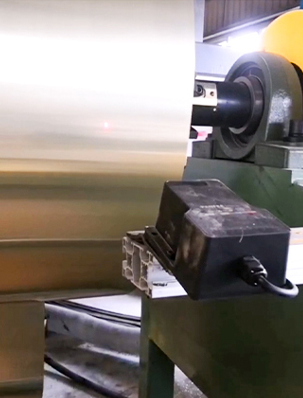
By installing a laser distance sensor near the winding drum, the system can continuously measure the height of the material on the coil, which is then converted into real-time coil diameter data.
Typical Working Principle
- The laser distance sensor is mounted beside the winding drum at a fixed position
- The laser beam is directed at the surface of the wound material
- The sensor continuously measures distance changes as the coil diameter increases
- Measurement data is transmitted to the control system (PLC / IPC)
- The control system determines whether the coil is full and triggers replacement signals
This approach enables real-time monitoring, automatic judgment, and process optimization throughout the winding operation.
4. System Benefits in Coil Diameter Monitoring
Using laser distance sensors in winding applications delivers several key advantages:
- Non-contact measurement with no mechanical wear
- Continuous real-time monitoring
- High measurement accuracy and repeatability
- Improved winding quality and process stability
- Reduced manual intervention and operator workload
The sensor also supports dynamic monitoring, allowing the system to adjust winding parameters based on real-time diameter changes, ensuring consistent tension and uniform material distribution.
5. Recommended Product for Coil Diameter Monitoring
L2S Laser Distance Sensor (RS485)
For coil diameter and material height monitoring, MyAntenna RF L2S laser distance sensor is a proven and cost-effective solution.
Why L2S Is Suitable for This Application
- 650 nm visible red single-point laser for easy alignment
- Measurement range up to 80 m
- Typical accuracy up to ±1 mm under ideal conditions
- Sampling rate up to 20 Hz, suitable for dynamic winding processes
- RS485 communication interface
- Standard Modbus RTU protocol for easy PLC and industrial computer integration
The L2S series is widely used in industrial automation scenarios such as:
- Coil diameter and material height measurement
- Material level and position monitoring
- Auxiliary positioning and alignment
- Robotic systems and gantry positioning
- Crane and rail positioning
- Industrial automation equipment
6. Application Value
By integrating laser distance sensors into winding systems, manufacturers can achieve:
- Automated coil full-detection
- Reduced downtime caused by late coil replacement
- Improved production continuity
- Enhanced overall equipment efficiency (OEE)
This solution is suitable for film winding, metal strip processing, paper rolls, textile fibers, and similar continuous production lines.
About MyAntenna RF
MyAntenna Technology Co.,Ltd. specializes in the development and manufacturing of industrial laser distance sensors and antenna solutions.
Our laser sensors are widely applied in industrial automation, material handling, manufacturing equipment, and smart factory systems, delivering reliable performance in demanding production environments.
If you are looking to improve measurement accuracy and automation in your winding process, our technical team is ready to support your application.
L2S vs L3 Laser Distance Sensors
RS485 Digital Output vs 4–20 mA Analog Output
1. Positioning Summary (Quick Decision Guide)
| Aspect | L2S (RS485) | L3 (4–20 mA) |
|---|---|---|
| Design focus | Automation & control | Safety & condition monitoring |
| Signal type | Digital communication | Industrial analog current |
| EMI resistance | High | Very high (industrial standard) |
| Typical systems | PLC / IPC / MCU | PLC / DCS / Safety systems |
| Best use cases | Dynamic control, fast response | Long-term monitoring, harsh sites |
In short: Choose L2S for control and automation. Choose L3 for monitoring and safety.
内链
在正文中自然插入以下内链(锚文本):
- RS485 laser distance sensor → L2S 产品页
- industrial automation sensors → 产品分类页
- material level measurement → Application 分类页
- winding process monitoring → Application / 页面
Related Products
No products selected in this application area