
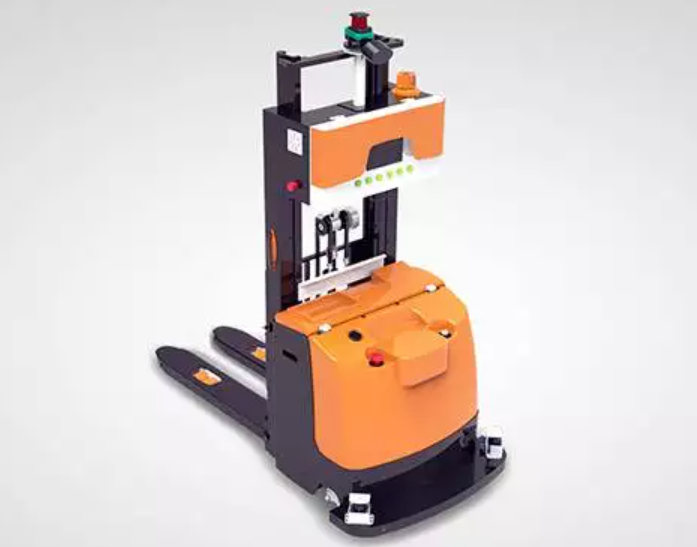
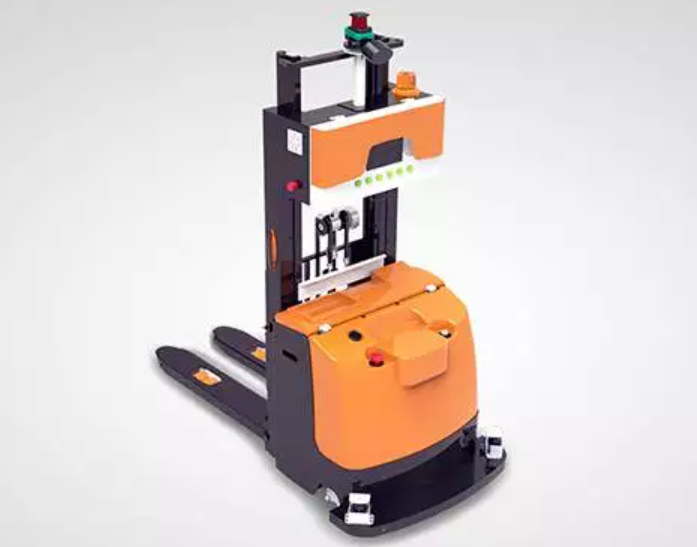
With the rapid development of automation technologies, intelligent forklifts have become widely adopted across warehousing and logistics operations. By leveraging autonomous navigation and perception/control technologies, intelligent forklifts can precisely transport and stack goods, significantly improving both handling efficiency and operational accuracy. This article introduces an application solution using a laser distance sensor for distance measurement on intelligent forklifts.
Background and Challenges
Compared with traditional manual handling, warehouse environments are often complex, and pallets placed by operators or trucks may not be positioned accurately. As a result, unmanned forklifts relying on conventional mechanical limit switches or monocular camera recognition may fail to identify pallets precisely. This frequently leads to large positional or angular misalignment during pallet docking, causing failed fork entry. When the pallet placement deviates from the preset position by a certain distance or angle, the forklift may fail to pick the pallet and require manual intervention—greatly reducing overall logistics efficiency.
Driven by the fast-growing demand for logistics automation, forklifts—the core equipment for material handling—are rapidly evolving toward intelligence. Key challenges that intelligent forklift manufacturers must address include precise positioning, automatic path planning, target pallet searching and detection, alignment, transportation, and loading/unloading operations.
Measurement Principle
Laser distance measurement works by emitting a laser beam toward a target and measuring the distance based on the returned reflected signal. For forklift height detection, a laser sensor is typically mounted at the top of the forklift and emits the laser beam upward. When the beam strikes the reference surface above, the reflected signal is received, and the distance is calculated. This method provides high measurement accuracy, but it requires a clear optical path—no obstacles between the sensor and the measured target.
Alternatively, the sensor can be mounted in the cab area or on the base of the lifting mechanism. The mounting point can be flexibly selected depending on the forklift model. In this setup, the laser emitter faces downward to measure the ground distance.
Recommended Sensor Model and Key Specifications
MyAntenna RF’s L4s-80 laser distance sensor is suitable for intelligent forklift distance measurement applications. Key specifications include:
- Measurement range: 0.03–80 m
- Accuracy: ±1 mm
- Interface: RS232
- Power supply: DC 5 V
Under static indoor measurement conditions (3 m distance to a white wall), the accuracy is ±1 mm. The maximum measurement rate is 10 Hz via the RS232 interface. The maximum range supports up to 80 m (a reflector must be installed at the reflective point).
Notes on Range, Accuracy, and Interface Data Rate
In general, reducing the measurement range does not necessarily improve accuracy. Additionally, different interfaces lead to different data transmission rates. As a general rule, the transmission speed ranking is:
TTL > RS232 > RS485 > 4–20 mA analog current output